

The Block Insights
House and Lot vs Condo: Which Is Better in the Philippines?
A house and lot and a condo are different assets, not different prices for the same thing. This guide breaks the decision into five trade-offs — ownership, cost shape, location, lifestyle control, and exit — and gives honest verdicts by buyer situation, from CBD professionals to OFWs buying for family.
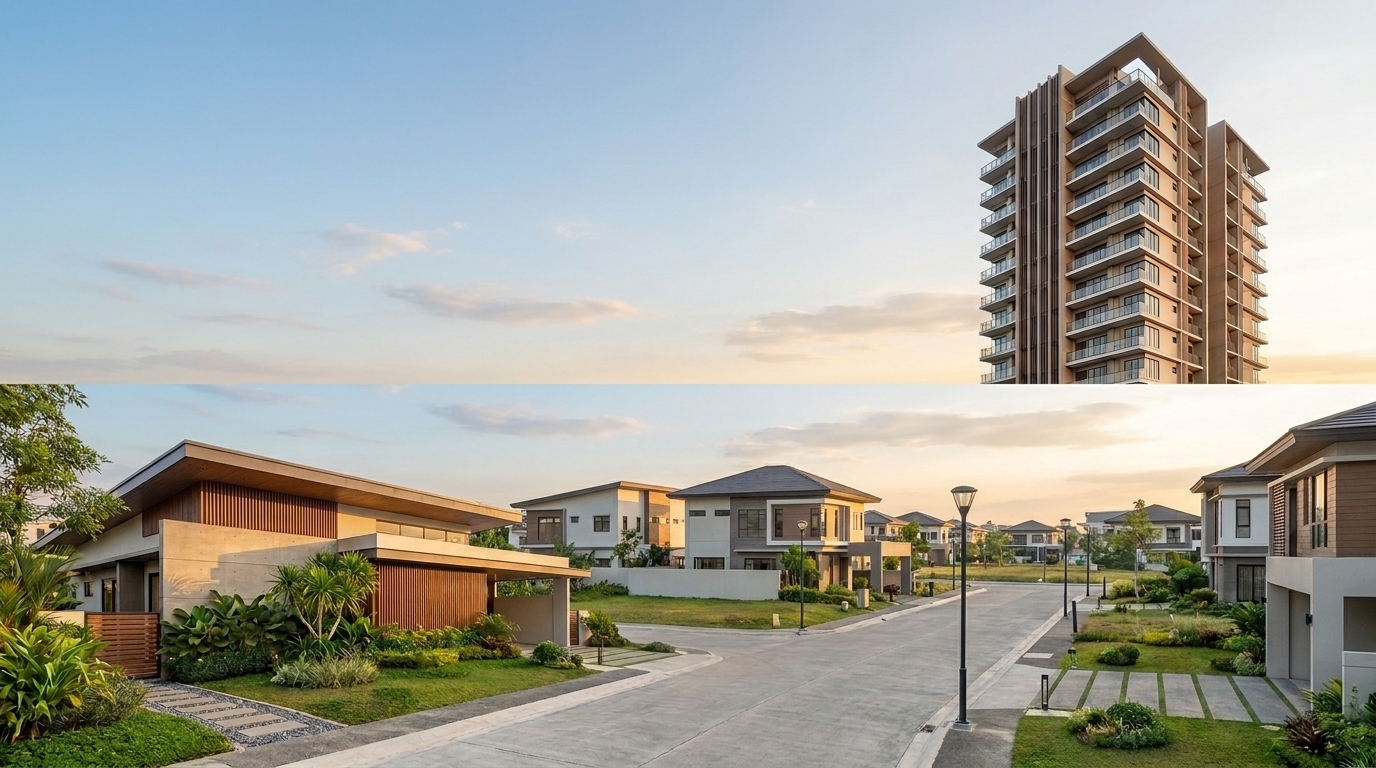
"Which is better?" is the question every first-time buyer asks, and it is quietly the wrong one. A house and lot and a condominium are not two versions of the same product at different prices. They are different assets, with different ownership structures, different cost shapes over time, and different ideas about how you should live. The better question is: which one is built for the life you are actually going to live for the next ten years?
This guide gives you the five trade-offs that decide it, an honest look at what each camp tends to gloss over, and clear verdicts by buyer situation. By the end, you will not need someone else's answer.
Trade-Off 1: What You Actually Own
Buy a house and lot and you own the land and everything standing on it, evidenced by a Transfer Certificate of Title. The lot is yours to build up, extend, rebuild, or leave to the next generation. Inside a subdivision you will still live under homeowners association rules, but the asset itself is fully yours.
Buy a condo and you own your unit — evidenced by a Condominium Certificate of Title — plus a shared interest in the land and common areas, held through a condominium corporation of which every owner is a member. You control your unit; you share control of everything that makes the unit livable, from elevators to reserve funds. Our condo buyer's guide unpacks what that structure means in practice; the short version is that a condo is a private space fused to a small private community, and you are buying both.
Why this trade-off matters more than buyers expect: the house-and-lot owner's biggest long-term decisions are theirs alone to make, while the condo owner's are made partly in common. Neither is inherently better. One is autonomy with responsibility; the other is convenience with shared governance.
Trade-Off 2: The Shape of the Costs
Compare honestly and the comparison must run past the purchase price.
A condo's costs are front-loaded in convenience and steady forever after: association dues billed monthly against your floor area, funding security, maintenance, and amenities — rising over the years, and continuing long after the mortgage is paid. Parking is typically a separate purchase. In exchange, when the hallway light dies or the roof deck leaks, it is someone's job, already budgeted, to fix it.
A house's costs are lumpier and self-managed. Subdivision dues are usually far lighter than condo dues, but every repair is yours: the roof after a bad typhoon season, the repaint, the gate motor, the plumbing. Owners who defer that maintenance do not save the money; they transfer it, with interest, to a future repair bill or a lower resale price. A house also quietly bills you in time — you are its property manager.
Over a 20-year horizon, neither reliably wins on total cost. The difference is predictability: the condo converts maintenance into a fixed monthly fee; the house converts it into irregular projects. Buyers who hate surprises tend to be happier in condos; buyers who hate paying for amenities they rarely use tend to be happier in houses.
Trade-Off 3: Location Versus Space
This is the trade-off that usually decides the matter in the Philippines, because our cities price it so sharply.
Condos exist where land is too expensive to buy whole — which is exactly where the jobs, hospitals, universities, and transit are. For a buyer working in a city center, the honest comparison is rarely "condo vs house at the same location"; it is a condo twenty minutes from work versus a house an hour and a half away on a good day. Filipino buyers know precisely what that commute costs in fuel, fares, and family time, and it belongs in the computation as surely as any peso figure.
Houses offer what no tower can: land, a garage that fits the whole family's vehicles, room for a garden, a second storey when the family grows, and distance from a neighbor's videoke. As growth corridors outside the traditional centers mature — with new roads, rail extensions, and business districts pulling employment outward — the house-and-lot commute equation improves in many areas, which is precisely why the decision deserves fresh eyes rather than inherited assumptions.
Trade-Off 4: Control, Change, and Daily Life
A house bends to your life. You can renovate the kitchen, add a room for a parent moving in, raise the fence, keep three dogs. The constraints are your budget, the building code, and comparatively light subdivision rules.
A condo asks your life to fit its rules. Renovations are regulated and approved; pets, leasing, even balcony use are governed by house rules; a growing family cannot add a bedroom to a fixed floor plan. In return, it grants what a standalone house rarely can: keyless travel — lock the door and leave for a month with nothing to worry about — building security, and amenities no single household could fund alone.
The question to ask is not "which lifestyle is better?" but "how much will my life change in ten years?" Buyers whose households are still growing tend to outgrow condos. Buyers whose households are stable or shrinking — young couples, empty nesters, solo professionals, an OFW's pied-à-terre — often find a house is more property than their life uses.
Trade-Off 5: Appreciation and the Exit
Here is the structural logic both sales teams simplify. Land does not wear out; structures do. A house and lot's value rests substantially on its land, which is why well-located lots have historically been resilient stores of value — and why an aging house on good land still sells, sometimes for the land alone. A condo's value rests on a depreciating structure whose fortunes are tied to how well the building is maintained and how the surrounding district evolves; a well-run tower in a strengthening district can perform well, while a poorly maintained one in an oversupplied area can stagnate regardless of what the brochure promised.
None of this makes either a guaranteed investment, and this article will not pretend to hand you appreciation percentages. The honest summary: a house and lot is the more forgiving long-hold asset because of the land beneath it; a condo's long-term outcome depends more heavily on factors outside your unit — the building's governance and the neighborhood's trajectory — which is exactly why due diligence on both matters so much.
On the exit side, think about who your future buyer or tenant is. Condos in employment centers rent faster and to a deeper pool; houses rent slower but often to longer-staying family tenants. Resale liquidity follows the same logic: the condo competes with every similar unit in the tower and the towers next door; the house competes in a thinner market but offers something scarcer.
At a Glance
| House & Lot | Condominium | |
|---|---|---|
| You own | Land + structure (TCT) | Unit + share of common areas (CCT) |
| Monthly carry | Light dues, self-managed repairs | Substantial dues, managed building |
| Location access | Farther from centers, improving with infrastructure | In or near employment centers |
| Flexibility | Renovate, extend, rebuild | Fixed floor plan, regulated changes |
| Security & lock-up-and-leave | Your arrangement | Built in |
| Long-hold value logic | Land-backed, forgiving | Building- and district-dependent |
| Renting it out | Slower, longer tenancies | Faster, deeper tenant pool |
Verdicts by Situation
Young professional working in a CBD: Condo. The commute math dominates, the lock-up-and-leave lifestyle fits, and the fixed floor plan is not yet a constraint. Buy the best-run building you can afford, not the flashiest amenities.
Growing family: House and lot, if the commute is survivable. Children convert bedrooms, yards, and storage from luxuries into requirements, and a condo's fixed floor plan is the constraint you will feel first.
OFW buying for family back home: Usually house and lot — the family lives in it daily and the land anchors long-term value — unless the family's life (work, school, healthcare) is genuinely city-centered, in which case a condo near those anchors serves better than a distant house nobody wants to commute from.
Starter investor for rental income: Condo near jobs or universities for velocity and ease of management; house and lot for patient, land-backed holding. Decide whether you are buying cash flow or buying land, and accept the trade honestly.
Retiree or empty nester: Condo for the security, elevator, and zero-maintenance life — provided the dues fit a fixed income permanently, not just comfortably today.
How to Actually Decide
Strip it to four questions. Where will the household's daily life — work, school, care — actually happen for the next ten years? How much will the household change in that time? Which cost shape suits you: fixed dues forever, or lumpy projects you manage? And when you eventually exit, do you want to be selling land, or selling a unit in a building whose condition you only partly control?
Answer those four and the "versus" resolves itself. Then the real work begins — and it is the same work either way: verifying the title or the license, vetting the developer or seller, and reading what you sign. Our step-by-step home-buying guide and condo buyer's guide take you through each path from there, and The Block Market puts the raw material of the decision in one place — house-and-lot and condo listings you can compare side by side, developer track records, and licensed professionals for the questions this article can only frame. The better choice is the one that fits the life you're building. Start building your blocks around it.
Ready to explore properties?
Search PropertiesAbout the Author
More from Nicole Abanilla
- What Is an Assume-Balance Property? Benefits, Risks and Warning SignsSeptember 13, 2026
- What Is a Transfer Certificate of Title or TCT?September 13, 2026
- What Is a Condominium Certificate of Title or CCT?September 13, 2026
Continue Reading

Pre-Selling vs Ready-for-Occupancy Property: Which Should You Buy?
Pre-selling is cheaper for a reason: the discount is payment for risks the developer is handing you — delivery, expectations, financing, and time. This guide prices each risk, shows how to shrink it, explains what RFO's premium actually buys, and gives clear verdicts for end-users, OFWs, and investors.
Nicole Abanilla · September 5, 2026 · 8 min read

What Is Equity in Real Estate? A Simple Guide for Filipino Homebuyers
In the Philippines, "equity" usually means the part of the price your loan won't cover — everywhere else, it means the share of your home you truly own. Both are correct, and understanding how the first becomes the second is one of the most useful ideas a homebuyer can carry into a showroom.
Ron Limon · September 7, 2026 · 8 min read

What Is a Reservation Fee? What Philippine Property Buyers Need to Know
A reservation fee takes a property off the market and starts your deadlines — and in standard Philippine practice it is non-refundable. This guide explains what the fee does, how it differs from a down payment and earnest money, the narrow paths to a refund, and the five checks to run before you pay.
Nicole Abanilla · September 7, 2026 · 8 min read